Nvidia DLSS 5 Leaks Ahead of Launch, and Modders Are Already Putting Its AI Graphics to the Test
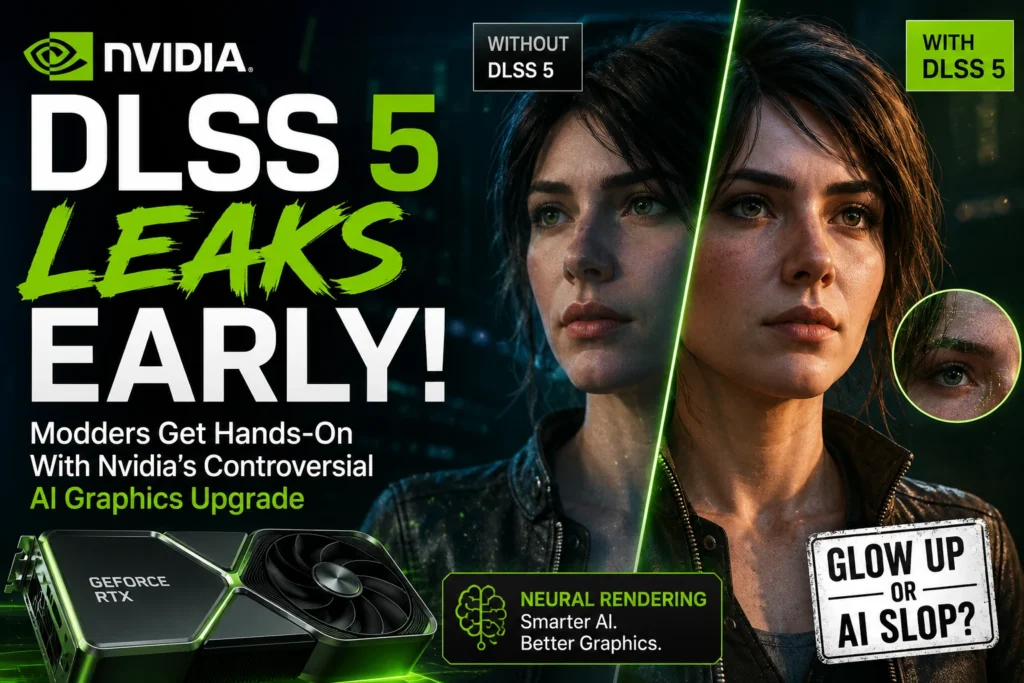
Nvidia’s next-generation DLSS technology has made an unexpected appearance ahead of its official release, giving PC gamers an early look at a feature that has already become one of the company’s most debated graphics technologies of 2026.
An experimental version of Nvidia DLSS 5, specifically its neural-rendering component, has reportedly leaked through an early-access build of NBA 2K27. Modders quickly extracted the relevant software and began experimenting with it in other PC games, including Control, Grand Theft Auto V, Cyberpunk 2077, The Last of Us Part II, and Elden Ring.
The results are proving to be a mixed bag. In some scenes, DLSS 5 can make lighting, skin, hair, shadows, and other details appear more realistic. In others, the effect can dramatically change a character’s appearance, producing the strange or overly processed look that caused controversy when Nvidia first demonstrated the technology.
The unofficial experiments are therefore raising an important question: Is DLSS 5 the next major leap in real-time graphics, or does it sometimes look more like an AI-powered visual filter?
What Is Nvidia DLSS 5?
DLSS, or Deep Learning Super Sampling, has traditionally been Nvidia’s AI-assisted technology for improving gaming performance and image quality. Earlier generations focused heavily on reconstructing higher-resolution images from lower-resolution frames while generating additional frames in supported games.
DLSS 5 takes that concept considerably further.
Nvidia introduced the technology in March 2026 as a form of neural rendering designed to use generative AI techniques to enhance visual elements in real time. Rather than simply reconstructing pixels, the technology can infer additional visual information and modify aspects of a rendered scene, including lighting, materials, shadows, hair, skin and other details.
That ambitious approach is also what created much of the controversy.
When Nvidia showed early demonstrations, some viewers felt the technology was changing the artistic appearance of game characters instead of simply improving the underlying graphics. Several demonstrations were criticized for giving characters an artificial or uncanny appearance, prompting the widely used “AI slop” criticism across gaming communities.
Nvidia, however, has argued that DLSS 5 is intended to remain under developers’ control. The company has subsequently demonstrated additional controls designed to let developers determine how strongly neural rendering affects a game.
How Did DLSS 5 Leak?
The early release appears to have originated from an early-access version of NBA 2K27.
According to reports from the modding community, users discovered a previously unseen Nvidia library inside the game’s files. The file, identified as nvngx_dlssnr.dll, is associated with DLSS neural rendering. The “NR” designation is believed to refer to “Neural Rendering.”
The DLL is reportedly around 158MB, substantially larger than the typical files associated with previous DLSS implementations. Once the file was discovered, members of the RenoDX modding community began investigating whether it could operate independently of NBA 2K27.
They soon found a way to integrate the technology into other games.
One of the earliest successful demonstrations involved Control, where modders were able to activate the neural-rendering component and apply it to character models. The experiment quickly spread through gaming communities, with additional attempts appearing in other titles.
This means gamers are effectively getting an unofficial preview of a technology Nvidia has not yet released publicly.
Modders Put DLSS 5 Into Other Games
The leak became particularly interesting when modders began moving beyond the original game.
The RenoDX community has experimented with integrating the leaked neural-rendering library into multiple titles. Reports have highlighted games such as Control, Cyberpunk 2077, Grand Theft Auto V, The Last of Us Part II, and Elden Ring.
However, these experiments should not be confused with official DLSS 5 support.
The games being modified were not necessarily designed or optimized around Nvidia’s new neural-rendering system. As a result, unusual visual artifacts, compatibility problems and significant performance penalties are possible.
In other words, the leaked version offers an intriguing glimpse at what the technology can do, but it does not necessarily represent the final DLSS 5 experience.
That distinction is especially important when evaluating the visual quality and performance shown in online videos.
Why Some DLSS 5 Results Look Strange
The biggest issue with the leaked technology is not that it fails to improve graphics. In many cases, it clearly can.
The problem is that neural rendering can become too aggressive.
Because DLSS 5 is designed to infer and enhance visual information, it can alter the way certain surfaces and characters appear. Hair can look more detailed, skin can appear smoother, shadows can become richer and lighting can appear more physically convincing.
But when the effect is pushed too far, the same process can create an unnatural result.
This has been particularly noticeable with human faces and recognizable characters. Some early demonstrations have produced appearances that users described as artificial, exaggerated or simply different from the original character design. Online reactions have ranged from excitement to outright rejection of the effect.
That is where the “AI slop” debate comes into play.
Critics argue that a game’s visual identity is created intentionally by artists, animators, lighting designers and character designers. If an AI system modifies those choices automatically, even if the result is technically more photorealistic, the game could lose part of its original artistic identity.
Nvidia’s position is that developers will have control over how the technology is implemented.
Nvidia Has Already Responded to the Backlash
The controversy surrounding DLSS 5 is not new.
When Nvidia first introduced the technology, gamers immediately questioned whether neural rendering could interfere with the artistic direction of games. Nvidia CEO Jensen Huang subsequently defended the approach, arguing that developers would remain in control of whether and how the technology is used.
Nvidia later provided a more detailed look at developer controls during SIGGRAPH 2026.
The company demonstrated controls that can adjust the intensity of neural-rendering effects, including settings related to structure and tone. Nvidia has also shown that developers can have more granular control over where the technology is applied.
That could be crucial.
A developer might, for example, want DLSS 5 to improve indirect lighting, hair illumination or subtle material details while avoiding aggressive modifications to a character’s face.
This approach would make DLSS 5 less of a universal “make everything photorealistic” switch and more of a graphics tool that developers can tune for individual games.
DLSS 5 Performance Could Be a Major Concern
Visual quality is only half of the story.
The leaked implementation also appears to be demanding on GPU hardware.
Early testing reported by modders suggests that the current version can cause substantial frame-rate reductions. One test on an RTX 5070 Ti at 4K resolution reportedly saw performance fall from approximately 71 frames per second to 35 FPS after enabling the technology.
Other reports have suggested frame-rate losses in the range of roughly 40% to 60% depending on the game and hardware.
Those numbers sound alarming, but they need to be interpreted carefully.
The software being tested is an unofficial, leaked implementation. The games were not necessarily optimized for it, and the exact graphics settings and internal rendering conditions used in individual tests are not always known.
Therefore, these results should not be treated as final DLSS 5 benchmarks.
Nvidia may also continue optimizing the technology before launch.
Is DLSS 5 Limited to RTX 50-Series GPUs?
The leaked version initially appeared to be restricted to Nvidia’s latest RTX 50-series Blackwell GPUs.
That would make sense given Nvidia’s positioning of the technology and the specialized capabilities available in newer architectures. However, modders have already been working on ways to run the leaked software on older RTX 40-series hardware.
Reports indicate that patched versions have allowed DLSS 5 experiments on GPUs such as the RTX 4080 and RTX 4090.
This does not mean Nvidia has officially announced RTX 40-series support.
Instead, it demonstrates how quickly the PC modding community can work around software restrictions.
Tom’s Hardware reported that some of the incompatibilities with previous-generation hardware could be addressed by patching the relevant CUDA binaries. However, older GPUs may still face architectural limitations, particularly where newer hardware capabilities are required.
For now, official hardware requirements remain something gamers should wait for Nvidia to confirm.
The Visual Improvements Are Real
Despite the controversy, it would be unfair to dismiss DLSS 5 entirely as a gimmick.
Some of the leaked demonstrations show meaningful improvements.
Neural rendering can enhance subtle lighting interactions that are difficult or expensive to reproduce using traditional rendering techniques. Examples include light passing through hair and foliage, contact shadows, skin illumination and other material-related effects.
In Control, early demonstrations have shown improved lighting and shadow behavior around characters without fundamentally rebuilding the game’s geometry.
That is an important distinction.
DLSS 5 is not necessarily replacing the game’s 3D models. Instead, the neural network can process rendered information and infer additional details that make the final image appear richer.
When the effect is carefully controlled, the result can be impressive.
The problem is that the same technology can become visually distracting when used too aggressively.
Why the Leak Matters for PC Gamers
The DLSS 5 leak is significant because it provides something that Nvidia’s controlled demonstrations cannot: real-world experimentation across many different games.
Developers and enthusiasts can now see how the technology behaves when it is removed from Nvidia’s carefully prepared demonstrations and introduced into existing game engines.
That experimentation could reveal both strengths and weaknesses before the official release.
It also highlights how powerful the PC modding community has become.
Within a very short period, modders identified the relevant library, extracted it from an early-access game and began experimenting with it elsewhere. The resulting screenshots and videos have given gamers a preview of Nvidia’s upcoming technology months—or at least weeks—before its planned public rollout.
At the same time, the leak could create unrealistic expectations.
A modified game running an unfinished neural-rendering implementation is not the same thing as a properly integrated commercial release. Developers will need to optimize the technology, determine where it should be used and tune its behavior for their particular art direction.
DLSS 5 Could Still Change Before Launch
Nvidia has said DLSS 5 is expected to launch in fall 2026.
That gives the company an opportunity to address many of the concerns raised by these early experiments.
The final version could have better performance, improved compatibility and more sophisticated developer controls. Nvidia has already demonstrated that the technology has evolved since its initial unveiling.
At SIGGRAPH 2026, the company showed a more controlled approach than some of the earliest DLSS 5 demonstrations that triggered backlash.
That suggests Nvidia is listening to at least some of the criticism.
The bigger question is whether developers will actually embrace the technology and use it carefully.
DLSS 5: Revolution or Overprocessed Graphics?
The leaked DLSS 5 implementation is fascinating precisely because it doesn’t provide a simple answer.
On one side, the technology demonstrates how AI could become a deeper part of real-time graphics. Instead of merely reconstructing an image, neural rendering can potentially add sophisticated lighting and material behavior without requiring developers to manually create every effect.
On the other side, the experiments show why AI-powered graphics need strong artistic controls.
Photorealism is not automatically better.
A stylized game, a horror title, an animated adventure or a carefully designed character can deliberately avoid realism. If an AI system changes those visual choices without enough control, it could make a technically sharper image that is artistically worse.
The current leak also demonstrates that performance remains a serious concern. Cutting frame rates dramatically to achieve subtle improvements in lighting will not appeal to every gamer.
Ultimately, DLSS 5 will have to prove that its visual benefits justify the additional GPU workload.
What Happens Next?
The leaked version of DLSS 5 is best viewed as an early technical preview, not a finished product.
Modders have demonstrated that Nvidia’s neural-rendering technology can already be extracted from an early-access game and adapted to unrelated titles. They have also exposed some impressive visual effects alongside major performance and compatibility questions.
For Nvidia, the leak is both an unwanted early exposure and an interesting public test.
Gamers now have a much clearer idea of what DLSS 5 can look like outside an official presentation. The company will ultimately have to show that the final release can deliver those improvements while maintaining game developers’ artistic control and avoiding excessive performance costs.
If Nvidia succeeds, DLSS 5 could represent a significant evolution of real-time game graphics.
If it does not, the technology could reinforce the concerns that emerged after its first demonstration.
For now, the verdict remains open. DLSS 5 looks capable of producing genuinely impressive graphics—but it also shows exactly why “more realistic” does not always mean “better.” The official launch will determine whether Nvidia can turn this controversial experiment into a practical upgrade for PC gaming.
About The Author